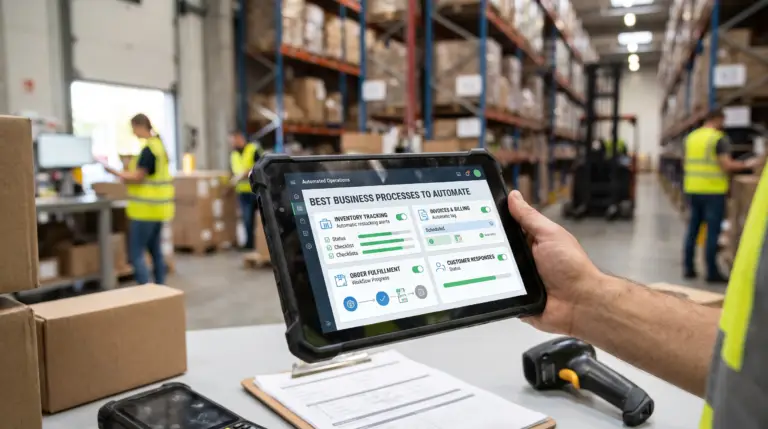
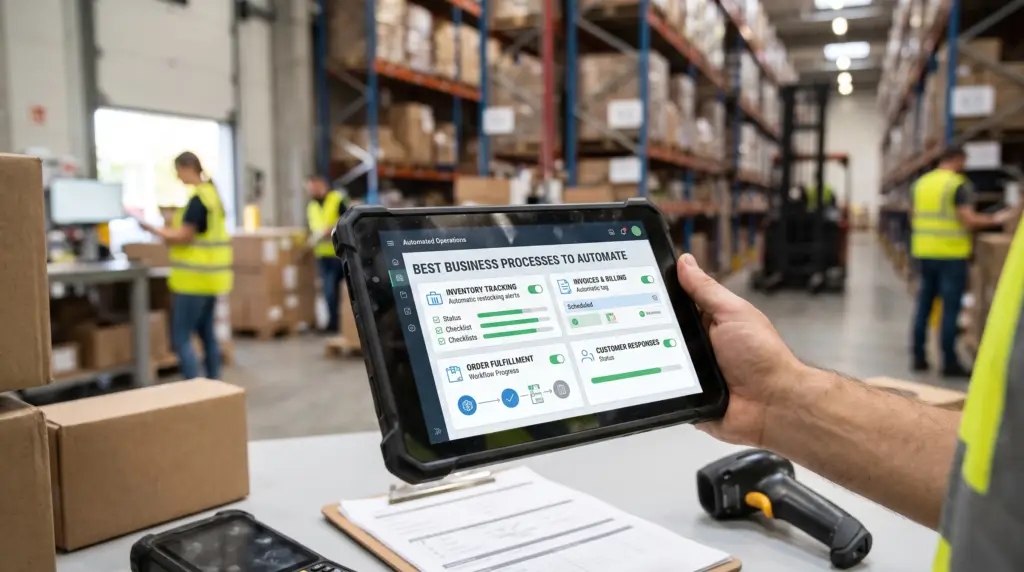
Which business processes should companies automate in 2027? Businesses should prioritize repetitive, time-consuming tasks such as invoice processing, customer support, appointment scheduling, employee onboarding, lead management, and data entry. Automating these activities helps reduce manual work, improve accuracy, save time, and allow employees to focus on more important business decisions.
Running a business involves managing multiple activities every day. From responding to customer inquiries to processing payments and tracking employee performance, even simple tasks can consume valuable working hours.
This is where business process automation becomes important. By combining automation software, AI tools, and connected business systems, companies can simplify daily operations and improve productivity.
Whether you manage a startup, small business, or established company, here are the best business processes to automate in 2027.
1. Customer Support and Inquiry Management
Customer support is one of the most valuable areas to automate. Businesses receive repetitive questions about pricing, services, appointments, order status, and account information.
Instead of manually responding to every inquiry, companies can use AI chatbots and automated support systems.
These tools can:
Answer frequently asked questions.
Collect customer information.
Route inquiries to the right department.
Provide order and booking updates.
Forward complex issues to human agents.
For example, a service-based company can use an AI chatbot to collect customer requirements and automatically send qualified inquiries to its sales team.
This improves response times while allowing employees to focus on conversations that require personal attention.
2. Invoice Processing and Financial Management
Managing invoices, payments, and financial records manually can create unnecessary administrative work.
Finance automation tools can simplify these activities by connecting accounting software, payment systems, and business databases.
Common processes to automate include:Generating and sending invoices.
Tracking payment deadlines.Sending payment reminders.Matching transactions with financial records.Organizing expense reports.
For example, when a customer completes a purchase, an automated system can generate an invoice, email it to the customer, and update the accounting records.
Businesses should still maintain human approval for sensitive financial transactions and unusual payments.
3. Lead Generation and Sales Follow-Ups
Sales teams often lose opportunities because inquiries are not followed up on time. Automating lead management helps businesses organize prospects and maintain consistent communication.
A CRM automation system can automatically:
Capture leads from website forms.
Assign inquiries to sales representatives.
Send personalized follow-up emails.
Update customer information.
Schedule meetings and reminders.
Track leads throughout the sales pipeline.
For example, when someone requests a demo through a website, the system can immediately send a confirmation email and notify the relevant salesperson.
This creates a more organized sales process and reduces the chances of missing potential customers.
4. Employee Onboarding and HR Management
Human resource departments handle several repetitive activities, particularly when hiring new employees.
HR automation simplifies administrative tasks and creates a smoother onboarding experience.
Businesses can automate:
Employee registration and documentation.
Welcome emails and onboarding checklists.
Interview scheduling.
Leave request notifications.
Attendance records.
Payroll information collection.
For example, once a candidate accepts a job offer, an automated workflow can send onboarding documents, notify HR, and create the employee's internal profile.
However, decisions involving hiring, performance evaluations, and sensitive employee matters should retain appropriate human oversight.
5. Inventory and Order Management
Retailers, eCommerce businesses, and distributors regularly manage inventory levels, customer orders, and supplier communication.
Manual inventory management can lead to delayed updates, stock shortages, and unnecessary administrative work.
Automation can help businesses:
Update stock levels after purchases.
Generate low-stock notifications.
Track incoming orders.Send order confirmation emails.
Create purchase requests.
Synchronize inventory across sales channels.
For example, when a product reaches its minimum stock level, the system can notify the purchasing department before inventory runs out.
6. Data Entry and Business Reporting
Data entry is another process that businesses can automate to reduce repetitive work.
Instead of manually transferring information between spreadsheets, forms, and software applications, companies can use automation tools to collect and organize information.
Automated reporting can also combine data from different systems and generate regular performance summaries.
Consider these research findings when evaluating automation opportunities:
Sources : McKinsey Global Institute, McKinsey Research, UiPath 2024 Global Knowledge Worker Survey
These findings demonstrate the potential of automation, although actual results depend on business processes, technology, and implementation.
7. Marketing and Email Campaign Management
Marketing teams often spend considerable time scheduling campaigns, organizing contacts, and sending repetitive communications.
Marketing automation makes these activities easier to manage.
Businesses can automate:
Welcome email sequences.
Customer follow-up campaigns.
Lead nurturing emails.Appointment reminders.
Customer segmentation.Campaign performance reports.
For example, when someone downloads an eBook from your website, an automated email sequence can deliver the resource and share relevant information about your services.
The goal is not to replace human creativity but to make marketing activities more consistent and efficient.
8. How Metaclosys Helps Businesses Automate Operations
Choosing the right automation strategy can be challenging, especially when a company uses multiple platforms for sales, marketing, finance, and customer management.
This is where Metaclosys can help businesses move toward smarter digital operations.
Through AI-powered solutions, custom software development, and digital transformation services, Metaclosys helps businesses explore ways to simplify workflows, connect systems, and improve operational efficiency.
Whether you want to automate customer inquiries, streamline internal processes, or develop a custom AI-powered solution, the right approach starts with understanding where your business spends the most time on repetitive work.
Rather than automating everything at once, identify your biggest operational challenges and build a solution around measurable business goals.
Frequently Asked Questions
1. What is business process automation?
Business process automation is the use of technology to perform repetitive business activities with minimal manual intervention. It helps organizations streamline workflows, reduce errors, save time, and improve productivity.
2. Which business processes should companies automate first?
Companies should start with repetitive, high-volume activities such as invoice processing, customer support, lead management, appointment scheduling, data entry, and employee onboarding. These processes often provide practical opportunities for automation.
3. How does AI improve business process automation?
AI improves business process automation by helping systems understand customer inquiries, process information, analyze data, generate responses, and support decision-making. When combined with workflow automation, AI can connect multiple business activities.
4. Is business process automation suitable for small businesses?
Yes. Small businesses can automate activities such as email marketing, customer inquiries, appointment reminders, invoicing, and lead follow-ups. Starting with affordable, simple automation tools can help reduce administrative workloads without requiring a large technology investment.
5. How can Metaclosys help with business process automation?
Metaclosys offers AI-powered solutions, custom software development, and digital transformation services to help businesses improve workflows and simplify operations. Businesses can explore automation solutions based on their operational requirements and growth objectives.