Should you use a no-code website builder or invest in custom website development for your business? A no-code builder is usually a practical choice for simple websites, portfolios, and landing pages because it offers ready-made templates and visual editing tools. Custom website development is better suited to businesses that need unique functionality, tailored integrations, greater design control, or room to scale.
Both approaches can help establish an online presence. The right choice depends on your business goals, technical requirements, budget, and plans for future growth.
What Is the Difference Between No-Code Builders and Custom Website Development?
No-code website builders let users create websites through visual editors, templates, and pre-built components without writing traditional code. Platforms such as Wix and Squarespace make it easier to launch and manage a basic website.
Custom Website Development involves designing and building a website around specific business requirements. Developers can create unique layouts, custom features, database connections, APIs, and integrations instead of relying entirely on a platform's available templates.
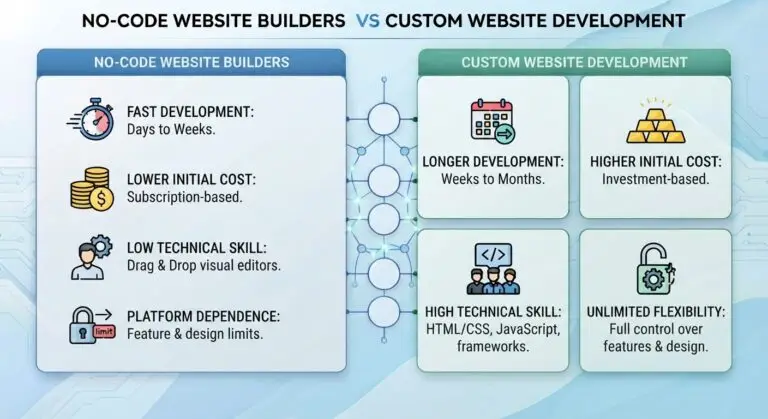
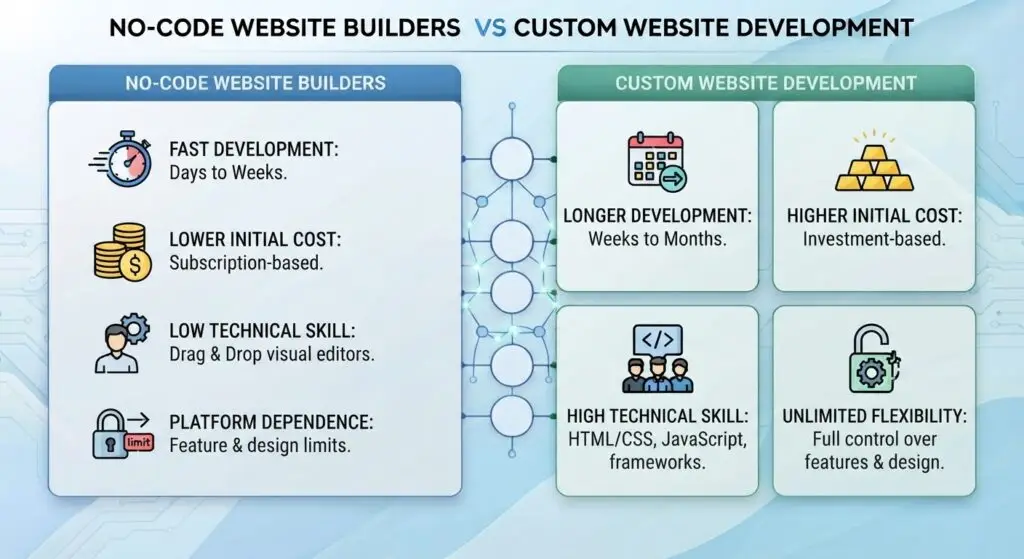
The main difference is flexibility. No-code tools prioritize convenience and speed, while custom development provides more control over how a website looks, works, and connects with other systems.
No-Code Website Builders vs Custom Website Development: Key Differences
The following comparison highlights how the two approaches differ.
Source: W3Techs
These percentages measure the share of all websites using each technology, not the percentage of businesses that prefer one development approach. WordPress is a content management system rather than a purely no-code builder, so it is included as a flexible middle-ground option.
1. Cost: Which Website Development Approach Is More Affordable?
No-code website builders generally have lower initial costs because they provide hosting, templates, and built-in tools through subscription plans. They can be suitable for startups and small businesses with limited budgets.
However, additional costs may arise from premium templates, third-party apps, advanced features, and subscription upgrades.
Custom website development usually requires a larger initial investment because developers plan, design, build, and test the website. The final cost depends on the number of pages, functionality, integrations, and technical complexity.
Best choice: No-code builders for simple websites and custom development when specialized features justify the investment.
2. Design and Functionality: How Much Control Do You Need?
No-code platforms offer ready-made layouts and visual editing tools. You can change colors, fonts, images, sections, and page structures without programming knowledge.
The limitation is that some features depend on the platform's available components and integrations.
Custom development offers more control over the user experience. A business can request unique navigation, interactive elements, advanced forms, customer portals, and specialized functionality.
For example, a local restaurant may only need a template-based website with a menu and contact details. A booking company may need custom scheduling, user accounts, payment processing, and automated notifications.
3. SEO and Website Performance
Both no-code builders and custom websites can support search engine optimization. The important factors include content quality, mobile usability, technical structure, page speed, and crawlability.
No-code platforms often provide basic SEO settings, such as editable page titles, meta descriptions, image alt text, and URL customization.
With custom website development, developers can configure technical SEO elements around the site's architecture. This may include structured data, internal linking, redirects, image optimization, and performance improvements.
Neither approach guarantees higher Google rankings. SEO results depend on how well the website is built, maintained, and optimized.
4. Scalability and Maintenance
A no-code website can be easy to maintain when your requirements are straightforward. However, businesses may encounter limitations when they need advanced integrations, complex workflows, or functionality that the platform does not support.
Custom development can be planned around future business requirements. Developers can build additional features, connect external systems, and modify the architecture as the website evolves.
Maintenance still matters. Custom websites require software updates, backups, security checks, and ongoing technical support. No-code platforms handle some infrastructure responsibilities, but business owners must still manage content, subscriptions, and integrations.
When Should You Choose a No-Code Website Builder?
A no-code website can be easy to maintain when your requirements are straightforward. However, businesses may encounter limitations when they need advanced integrations, complex workflows, or functionality that the platform does not support.
Custom development can be planned around future business requirements. Developers can build additional features, connect external systems, and modify the architecture as the website evolves.
Maintenance still matters. Custom websites require software updates, backups, security checks, and ongoing technical support. No-code platforms handle some infrastructure responsibilities, but business owners must still manage content, subscriptions, and integrations.
When Is Custom Website Development the Better Choice?
Custom development is worth considering when your website needs more than standard templates and built-in features.
It may be the better option if you need:
A unique design aligned with your brand.
Custom booking or payment functionality.
Customer dashboards and user accounts.
CRM, ERP, or third-party API integrations.
Advanced business workflows.
A scalable platform designed around your operations.
For example, a company offering subscription-based services may need account management, automated billing, customer permissions, and reporting dashboards. A custom solution can be designed around these requirements.
How Metaclosys Helps Businesses With Custom Website Development
If you are unsure whether a website builder can support your business requirements, it helps to discuss the project before choosing a platform.
Metaclosys helps businesses develop websites based on their brand, functionality, and growth goals. Its services include custom website design, responsive development, WordPress solutions, custom web applications, SEO foundations, and third-party integrations.
For example, a professional services company may need lead-generation forms and CRM connections, while a growing business may require a custom dashboard or booking system.
Rather than forcing every project into a ready-made template, Metaclosys can help identify an appropriate development approach for the features you actually need. Explore Metaclosys website development services to learn more.
Frequently Asked Questions
1. Is custom website development better than a no-code website builder?
Custom development is better when a business needs unique functionality, advanced integrations, and greater control. No-code builders are often better for simple websites that need to launch quickly.
2. Are no-code website builders good for small businesses?
Yes. They can help small businesses create websites without hiring developers. They are particularly useful for basic service websites, portfolios, and landing pages.
3. Is custom website development more expensive?
It generally has a higher initial cost because it involves planning, design, development, and testing. However, the total cost depends on project complexity, maintenance, and future requirements.
4. Can no-code websites rank on Google?
Yes. No-code websites can appear in Google search results when they have useful content, accessible pages, good technical SEO, and a positive user experience. The platform alone does not determine rankings.
5. When should a business move from a website builder to custom development?
Consider moving when your existing platform cannot support important features, integrations, workflows, or performance requirements. A migration should be planned carefully to protect existing URLs, content, and search visibility.