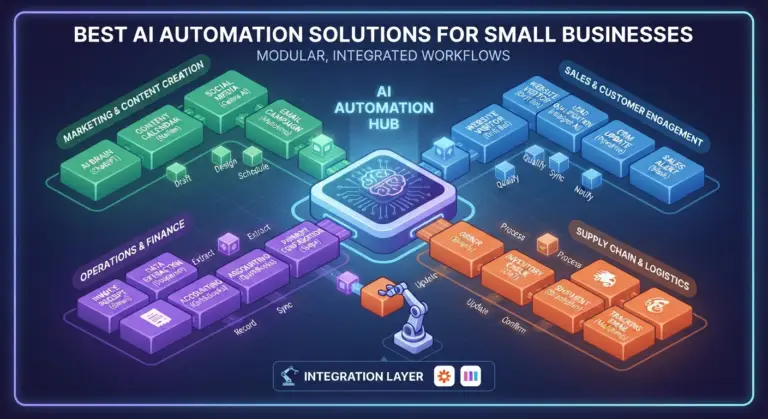
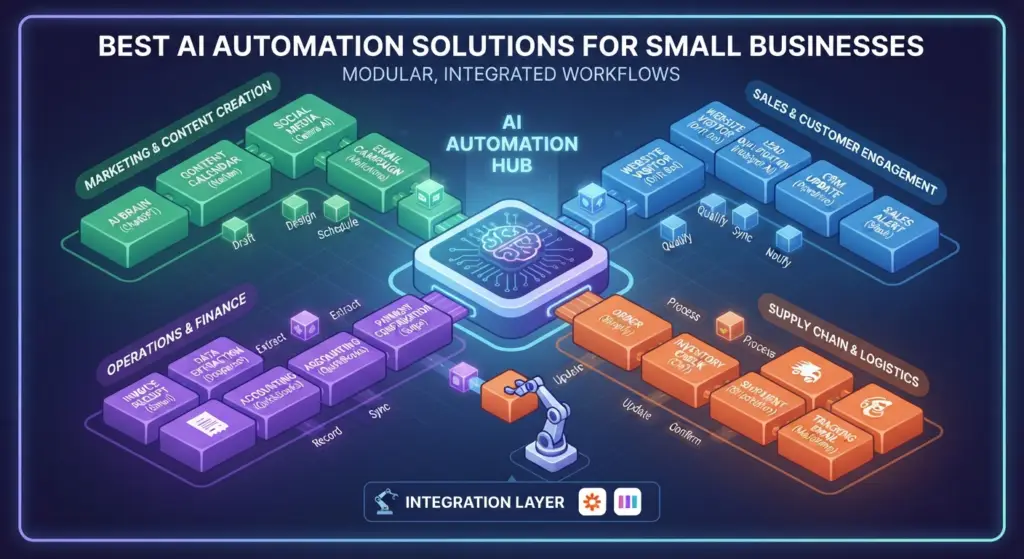
Which AI automation solutions can help small businesses save time, manage customers, and improve daily operations in 2027? The most useful options include AI-powered customer support, automated marketing, sales follow-ups, and workflow management. Tools such as Zapier, HubSpot, and Microsoft Power Automate can connect business applications, while custom AI chatbots and AI agents can handle tasks that require more context.
For small businesses, the goal is not to automate everything. It is to identify repetitive tasks that consume valuable time and use the right technology to make those processes faster, more consistent, and easier to manage.
What Are the Best AI Automation Solutions for Small Businesses?
The best AI Automation Solutions depend on your business needs. Some companies need help responding to customer inquiries, while others want to automate marketing campaigns, organize leads, or reduce manual administration.
The following categories are practical starting points. The statistics are from the Federal Reserve's 2026 Report on Employer Firms and describe businesses already using AI.
Source: Federal Reserve.
These figures show where businesses are applying AI today. They are not guaranteed results for every small business, but they help identify useful areas for automation.
1. AI Customer Service and Support Automation
Customer service is one of the most practical areas to automate. Small businesses often receive inquiries through websites, phone calls, email, and social media. Responding manually to every message can take time away from important work.
AI chatbots can answer frequently asked questions, explain services, collect customer details, and direct complex requests to the appropriate team member.
For example, a dental clinic can use a chatbot to answer questions about appointments, while a home service company can collect customer information and organize quote requests.
Solutions to explore: Custom AI chatbots, AI receptionists, and customer support automation platforms.
2. AI Marketing and Email Automation
Marketing automation helps small businesses communicate with customers without manually managing every interaction.
AI-powered marketing tools can assist with content creation, audience segmentation, email personalization, and campaign workflows. For example, when someone subscribes to a newsletter, an automated system can send a welcome email and schedule relevant follow-up messages.
Platforms such as HubSpot and Brevo offer marketing automation features that businesses can explore.
However, AI-generated content should always be reviewed for accuracy, brand voice, and relevance before publication.
3. AI Workflow and Task Automation
Many businesses still move information manually between spreadsheets, forms, email accounts, and project management tools. Workflow automation connects these systems and reduces repetitive administrative work.
For example, when a customer submits a website form, an automated workflow can:
Add the contact to a CRM.
Send an inquiry confirmation email.
Notify the sales team.
Create a follow-up task.
Udate the lead status.
Zapier and Make are useful options for connecting different business applications. Businesses using Microsoft products can also explore Power Automate.
4. AI Sales and Lead Management
Following up with potential customers is important, but small teams can easily lose track of inquiries. AI-powered sales automation can organize incoming leads, summarize conversations, prioritize inquiries, and trigger follow-up reminders.
A service business, for example, can automatically send a confirmation after someone requests a quote. The CRM can then assign the inquiry to a sales representative and remind the team to follow up.
These workflows help businesses maintain consistent communication without relying entirely on manual reminders.
5. AI Accounting and Administrative Automation
Administrative work includes organizing invoices, processing documents, updating records, and managing routine business information.
AI-powered accounting and document-processing solutions can help extract information from invoices, categorize transactions, and organize records. Accounting platforms such as QuickBooks offer automation features that businesses can evaluate for their financial workflows.
Sensitive financial information should be handled through secure systems, with human review for important transactions and accounting decisions.
How Should Small Businesses Choose AI Automation Software?
Choosing the right software starts with understanding the problem you want to solve.
Identify Repetitive Tasks
List the activities your team performs regularly. These might include responding to common questions, sending follow-up emails, updating customer records, or preparing reports.
Check Integrations
Choose software that works with your existing CRM, website, email, calendar, and accounting systems. Poor integration can create more manual work instead of reducing it.
Compare Costs and Scalability
Review subscription fees, usage limits, integration charges, and implementation costs. Start with essential features and expand when the automation delivers practical value.
Prioritize Security and Human Oversight
Check how the provider handles business data, user permissions, and access controls. Keep human approval for sensitive decisions, customer complaints, financial transactions, and other high-impact tasks.
How Metaclosys Helps Small Businesses Implement AI Automation
Choosing software is only part of the process. Businesses also need automation that fits their existing operations.
Metaclosys helps small businesses build practical AI systems through custom chatbots, AI receptionists, voice agents, LLM integrations, and automated workflows. These solutions can connect with existing CRMs, email platforms, calendars, and booking systems.
For example, a law firm may need automated client intake, while a salon may benefit from appointment booking and reminders. A home service company could use an AI receptionist to answer calls, capture quote requests, and route inquiries to its team.
Metaclosys focuses on building solutions around actual business workflows rather than adding unnecessary software. Explore its AI Automation and Integration Services to learn how automation can support your operations.
Frequently Asked Questions
1. What are the best AI automation solutions for small businesses?
Useful options include AI chatbots, AI receptionists, marketing automation, CRM workflows, document processing, and automated reporting. The right choice depends on the tasks a business wants to improve.
2. How can AI automation help a small business?
AI automation can reduce repetitive manual work, organize information, support customer communication, and help employees focus on more valuable tasks.
3. Is AI automation expensive for small businesses?
Costs vary depending on the software, integrations, usage, and level of customization. Businesses can start with subscription-based tools and consider custom solutions when standard software does not meet their requirements.
4. Can AI automation work with existing business software?
Yes. Many automation platforms connect with CRMs, email services, calendars, spreadsheets, and other applications through integrations and APIs. Compatibility should be checked before implementation.
5. Should small businesses use custom AI automation or ready-made software?
Ready-made software is often suitable for common tasks such as email automation and CRM updates. Custom AI automation is more appropriate when a business has specialized workflows, unique integrations, or requirements that standard platforms cannot handle.